
Blog Details
- Member
- November 12, 2026
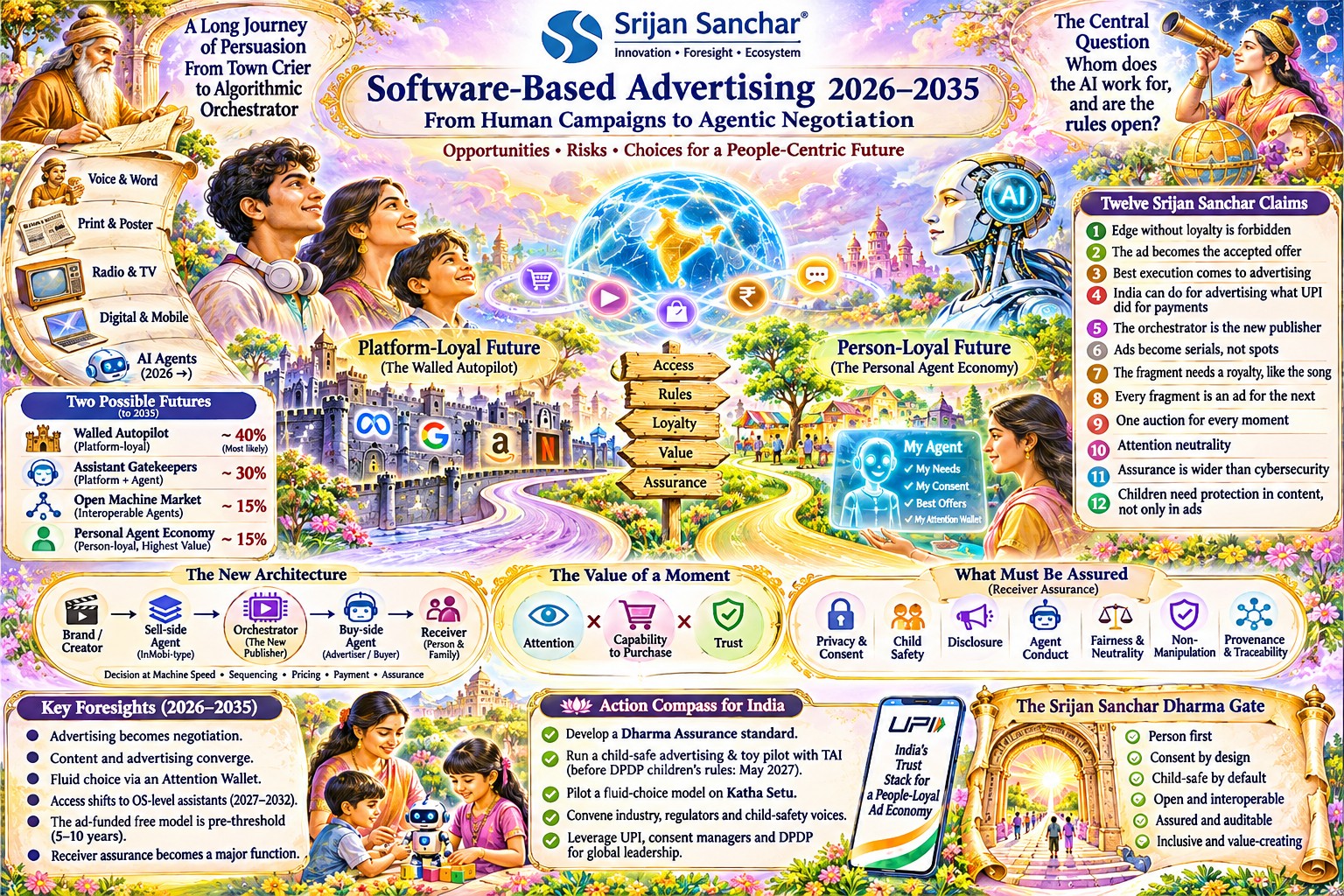
Software Based Advertising A Srijan Sanchar Foresight 2026 to 2035
Srijan Sanchar · Shailendra Jaiswal · 12
November 2026
Summary
Software-based
advertising is moving from humans buying screens to AI agents negotiating with
AI agents. In 2026 advertising is a $1.3 trillion market growing at 8.9%, and
Alphabet, Meta and Amazon take 57.6% of it outside China. AI now runs campaigns
end to end, chatbot answers are becoming the fastest-growing ad surface, and
commerce ads have overtaken television. This inquiry began with InMobi, whose
decision engine, sell-side agents and Glance surfaces show the selling side is
already agent-ready. Read through IEF v3, the history of advertising reveals
one tension recurring at every stage: whose interest the system serves. The
forecast is a bifurcation between platform-loyal and person-loyal futures.
Two
questions decide the future to 2035: whom the AI works for, and whether the
rules are open. Today’s walled autopilot is most likely, at about 40%. The
personal agent economy, where people’s own agents post needs and collect
verified offers on public rails, is the most valuable, at about 15%. Assistant
gatekeepers and an open machine market lie between. The central insight is
order: open the rules before personalising the agent, because intelligence on
the device that stays loyal to sellers becomes manipulation, and assistants
built inside closed platforms become new toll gates.
Content
now behaves like advertising, since both must reach the same receiver through
the same agent. No single payment model wins. Hybrid tiers dominate to about
2030, after which fluid choice rises, letting people pay, watch or share at any
moment through an attention wallet holding money, attention, data and
contribution. Content is also fragmenting into clips and chapters, and ads are
becoming serials told across many creators. Value therefore moves to the
orchestrator, the algorithm that picks, sequences, prices and pays. The
orchestrator becomes the new publisher, and value concentrates at both ends of
the smile curve: original work and the relationship with the receiver.
The
value of a moment is attention multiplied by capability to purchase and by
trust. Access is moving from feeds to phone assistants between 2027 and 2032,
because they are the first gate to see both intent and ability to pay. This
creates risks of attention inequality, wealth guessing and exploiting children,
which calls for attention neutrality. Structural Threshold Foresight places the
ad-funded free model in a pre-threshold state, five to ten years from breaking.
It also signals receiver assurance: independent proof that privacy, children
and fair conduct are protected. This is wider than cybersecurity, because it
guards against legitimate actors behaving badly, not only attackers.
For
Srijan Sanchar this is a thought-leadership opportunity grounded in its Dharma
gate. Twelve novel claims are ready to publish, from “the ad becomes the
accepted offer” to “attention neutrality”. Recommended actions stay exploratory
while the threshold is uncertain: a Dharma Assurance standard, a child-safe toy
pilot with TAI before India’s children’s data rules apply in May 2027, a
fluid-choice pilot on Katha Setu, and a convening of industry, regulators and
child-safety voices. India’s UPI, consent managers and DPDP Act make it well
placed to lead.
At a glance
|
Indicator (2026) |
Value |
Source |
|
Global ad revenue |
$1.3 trillion, +8.9% |
WPP Media |
|
Share taken by Alphabet,
Meta, Amazon (outside China) |
57.6% |
WPP Media |
|
Ads in AI search |
$5.1B in 2026, $100B+
forecast by 2030 |
WPP Media |
|
Ad plans’ share of new
Netflix sign-ups in ad markets |
Over 60% (Q1 2026) |
PPC Land |
|
Advertiser-side
verification (DoubleVerify) |
$748M revenue, 2025 |
Company results |
The core foresights.
1.
Advertising becomes
negotiation. The unit shifts from the impression to
the offer an agent accepts.
2.
Two questions decide the
future: whom the AI works for, and whether the
rules are open. The walled autopilot is the default (about 40%); the personal
agent economy is the highest-value path (about 15%).
3.
Open the rules before
personalising the agent. Device intelligence
without loyalty to the person is a forbidden zone.
4.
Content and advertising
converge. Fluid choice through an attention wallet
becomes the leading payment model.
5.
The orchestrator is the new
publisher. Algorithms weaving fragments and serial
ads capture most of the value.
6.
Access moves to OS-level
assistants (about 2027–2032).
7.
The ad-funded free model is
pre-threshold (5–10 years).
8.
Receiver assurance becomes a
major function, wider than cybersecurity.
Claims Srijan Sanchar can stake: Edge
without loyalty is forbidden · The ad becomes the accepted offer · Best
execution comes to advertising · India can do for advertising what UPI did for
payments · The orchestrator is the new publisher · Ads become serials, not
spots · The fragment needs a royalty, like the song · Every fragment is an ad
for the next · One auction for every moment · Attention neutrality · Assurance
is wider than cybersecurity · Children need protection in content, not only in
ads.
1. Starting
point: InMobi through IEF v3
InMobi has built the sell side of agentic advertising. IEF v3 shows
the open fork is whether software advertising stays loyal to platforms or turns
loyal to the person.
What InMobi has built (2025–26). The
Mobius decision system makes 25T+ predictions a day across 200B+ ad
opportunities and leaves a “decision trace”. A sell-side agent built with
Scope3 opened mobile and CTV supply, including Glance’s ~300M active devices,
to AI buying agents. A conversational agent on Buyer Hub serves traders. InMobi
acquired MobileAction, and its founders bought out SoftBank ahead of an
expected India IPO. What remains open: no agent represents the person, consent
is a cost rather than a priced asset, and nothing proves an agent acted for its
principal.
|
IEF step |
Result |
|
Phenomenon and
objective |
Software
advertising after agent-to-agent buying; horizon 2027–2031; act on theses at
medium probability or higher |
|
Thesis inventory |
22 theses across
five tiers, with 2 axis candidates, 4 matrix seeds, 3 quadrant flags and 1
forbidden zone |
|
CCN genealogy |
Five nodes
(banners → search → programmatic → privacy turn → agentic); one polarity
recurs: whose interest the system serves |
|
Constraint field |
C1 auditable
unit of exchange; C2 tie the ad to expressed intent; C3 verifiable supply
path; C4 revocable, purpose-limited consent and no child targeting; C5 every
autonomous decision traceable with human override |
|
Axes |
Axis 1: Agent
loyalty (platform → advertiser → mutual → person). Axis 2: Intelligence locus
(cloud → on-device) |
|
Matrix reading |
Two clusters
with a gap; forbidden cells at the device end of the platform and advertiser
rows: edge without loyalty is forbidden |
|
Forecast state |
Bifurcation:
platform cluster ~55%, person cluster ~30% by 2031 |
|
Target cell |
Consent-priced
intent exchange: the person’s on-device agent posts intent windows, sellers’
agents bid with verifiable offers, a share of value funds content |
|
Trajectory |
Loyalty shifts
before locus: best-execution receipts → consent-artefact signals → negotiated
offer protocol → target |
2. Global context in 2026
Advertising is a $1.3 trillion market growing faster than the
economy. Three firms take most of it, and AI is both its growth engine and its
biggest disruptor.
|
Fact (2026) |
What it tells us |
|
Global ad
revenue grows 8.9% to $1.3T, its highest share of GDP since 1999 |
AI-run
performance ads drive growth |
|
Alphabet, Meta
and Amazon take 57.6% outside China |
Software
platforms now own advertising |
|
Commerce ads
reached $178B in 2025 and overtook TV |
Ads move to the
point of purchase |
|
Generative-search
ads: $5.1B in 2026, $100B+ by 2030 |
AI answers are
the fastest-growing ad surface |
|
ChatGPT ads
launched Feb 2026; $100M+ annualised in six weeks; no ads to under-18s |
Chatbots adopt
ads, with stated limits |
|
Meta aims to
automate ads end to end |
The media buyer
is automated away |
|
Rival
agent-buying standards: AdCP (2025) and IAB Tech Lab’s AAMP (2026) |
Agent trading is
real; the rules are contested |
|
Google kept
third-party cookies and retired most Privacy Sandbox tools (Oct 2025) |
Privacy moves to
law and device |
|
US court (Sept
2026): Google keeps AdX but must open its ad tech, under six years’ oversight |
Regulators open
the plumbing rather than break up platforms |
|
# |
Force reshaping advertising |
Pulls toward |
|
1 |
AI runs the
whole campaign |
Platforms |
|
2 |
Answers replace
search results |
AI owners |
|
3 |
Commerce absorbs
advertising |
Platforms with
purchase data |
|
4 |
Agents trade
with agents |
Undecided:
depends on the rules |
|
5 |
Screens
multiply: TV, lock screen, car, glasses |
Device makers |
|
6 |
Privacy moves
from browser to law and device |
People, if law
holds |
|
7 |
Regulators open
the plumbing; children’s rules tighten |
Challengers and
publishers |
|
8 |
Trust becomes
scarce as AI content floods feeds |
Whoever can
prove authenticity |
3. Four futures to 2035
Two questions decide the future: whom does the AI work for, and are
the rules open or closed? The walled autopilot is the most likely; the personal
agent economy is the most valuable, and it is reached by opening the rules
first.

Four futures to 2035: who the AI serves and how open the rules are
•
Walled autopilot (about
40%): the default path. Ads get cheaper and better
targeted, but a few firms set prices and publishers lose income.
•
Assistant gatekeepers (about
25%): assistants from phone makers and chatbot
firms shop for users, but sellers pay a toll to be seen.
•
Open machine market (about
20%): open protocols and antitrust remedies let
many sellers compete, but agents still serve the seller.
•
Personal agent economy
(about 15%): people’s own agents negotiate on open
rails, needing open protocols, consent law and trusted public infrastructure,
all of which India has in other sectors.
4. Ten foresights with
timing
|
# |
Foresight |
Roughly by |
Confidence |
|
1 |
The media buyer
becomes a supervisor |
2027 |
High |
|
2 |
AI answers
become the biggest new ad surface ($100B+) |
2030 |
Medium-high |
|
3 |
Agents trade
with agents by default |
2029 |
Medium-high |
|
4 |
The ad becomes
the accepted offer |
2030 |
Medium |
|
5 |
Best execution
comes to advertising |
2030 |
Medium |
|
6 |
Free content
needs new funding (AI licensing, ad revenue shares) |
2030 |
Medium |
|
7 |
Personal
shopping agents go mainstream |
2031 |
Medium |
|
8 |
Proof of
authenticity earns a premium |
2031 |
Medium |
|
9 |
Consent becomes
a priced, portable asset |
2033 |
Low-medium |
|
10 |
Public rails for
advertising emerge, like UPI |
2035 |
Low-medium |
Foresights 1–3 are under way and favour platforms; 4–7 are the
turning point; 8–10 decide whether people and small firms gain power, and
depend on choices made before 2029.
5.
Content and advertising converge: who pays for attention?
Content now behaves like advertising: it must reach a receiver, and
soon the receiver’s agent decides what gets through. No single payment model
wins. By 2035 the leading model is fluid choice: at any moment the receiver, or
their agent, pays with money, attention, data or contribution. Ad-supported
plans were 57% of new US streaming sign-ups in Q1 2025, and Netflix’s ad plan
took over 60% of Q1 2026 sign-ups in its ad markets.
|
Model |
How the receiver pays |
Outlook to 2035 |
|
Pay for content |
Money |
A stable premium
layer; subscription fatigue limits it |
|
Watch ads, get
content free |
Attention and
data |
Largest by
reach, but each ad earns less |
|
Hybrid tiers |
The receiver
picks a plan |
Dominant to
about 2030 |
|
Fluid choice |
Per piece or per
minute, in the moment |
Rises after 2029
where instant payment rails exist; India well placed |
Other models will coexist: micropayments (₹1 per story), paying with
consent, your agent paying creators from purchase commissions, AI licensing,
commerce-funded content, patronage, public and CSR funding, earning to view,
and paying with contribution.
The attention wallet. Each person holds
four currencies: money, attention, data and contribution. Their agent pays for
each piece of content in the cheapest acceptable currency, within limits the
person sets. Content will have to pitch like an ad, and ads will have to deliver
value like content. Children’s content stays ad-free in every model.
6.
Fractional content, serial ads and the orchestrator
Content is breaking into fragments, and one brand message is split
into episodes woven across many creators’ content. This needs coordination, so
value moves to whoever orchestrates: the algorithm that picks, sequences,
prices and splits the payment. The orchestrator is the new publisher.

Fractional content and serial ads: the orchestrator in the middle
|
Shift |
What changes |
Who gains, who loses |
Roughly by |
|
Fractional
content |
The unit of
consumption and payment becomes the fragment |
Gains: snackable
formats. Loses: long-form makers unless valued per fragment |
Under way |
|
Serial ads
across content |
Campaigns become
episodes measured by whether the story completed |
Gains: brands
with story skills. Loses: single-spot sellers |
2028–30 |
|
More
coordination |
Sequence,
frequency, rights and payment splits agreed across parties |
Gains:
protocols, clearing houses |
2028–31 |
|
Value shifts to
algorithms |
The orchestrator
keeps most of the margin |
Gains:
orchestrator owner. Loses: creators’ bargaining power |
Already visible |
If the platform’s algorithm orchestrates, control concentrates
further; if the person’s own agent orchestrates on the device, ads can be woven
in without cross-app tracking and creators paid directly. The shift needs
fragment royalties (like IPRS for songs), serial-ad rules, orchestrator
accountability and creators’ right to refuse unsuitable placements.
7.
Attention × capability to purchase × trust: who controls access?
The scarce resource is qualified attention. Value of a moment ≈
Attention × Capability to purchase × Trust. Content, its own promotion and
others’ ads now sit on one spectrum, from pure content, through content
advertising itself (“every fragment is an ad for the next”), others’ ads inside
content and brand-made content, to ads good enough to be chosen. One auction
decides every moment: a fragment bids with engagement, an ad with money, a
self-promotion with future subscriptions.
|
Gate to access |
Controlled today by |
Contest to 2035 |
|
The person |
Attention, time,
consent |
Gains power only
with their own agent and enforced consent |
|
Device and OS |
Apple, Google,
phone makers |
Strongest gate
as assistants move into the OS |
|
AI assistant |
Chatbot and
phone-assistant makers |
The new front
door: sees intent and capability together |
|
Feed and
orchestrator |
Video, social,
streaming platforms |
Powerful,
increasingly reached through assistants |
|
Search and
discovery |
Search engines,
AI answers |
Shrinks as
answers replace visits |
|
Payment and
identity rails |
App stores, card
networks, UPI |
Decides whether
fluid choice is possible |
|
Network and
bundles |
Telecom
operators |
Strong in India |
|
Rules |
Competition,
consent, child-protection law |
Decides whether
gates stay open and neutral |
Control shifts toward OS-level assistants, roughly 2027–2032; in
India, super-apps and telecom bundles may hold the gate. Risks include
attention inequality, capability scoring, monetising children through parents,
blurred labels and closed gates. The remedy proposed is attention neutrality:
no gate may favour its owner’s content or ads without disclosing it.
8.
Receiver assurance: wider than cybersecurity
As agents decide what reaches people, a new function becomes
necessary: independent assurance that receivers are not tracked beyond consent,
children are not influenced, and algorithms behave as they claim. We expect it
to become a major function by about 2030 (high confidence); whether it stays
independent is open (medium confidence).
India’s DPDP Rules were notified on 13 Nov 2025; consent managers
register from 13 Nov 2026, and fiduciary and children’s obligations apply from
13 May 2027. The EU’s DSA Article 28 bars profiling-based ads to known minors.
Yet a 2026 audit of TikTok found formal compliance alongside promotional
content profiled to minors 5–8 times more strongly than formal ads to adults.
Today’s verification industry (DoubleVerify $748M in 2025; IAS $530M in 2024)
protects the advertiser, not the receiver.
|
# |
Assurance domain |
Question it answers |
|
1 |
Privacy and
consent |
Was data used
only within consent, and did withdrawal take effect? |
|
2 |
Child safety |
Were children
kept out of profiling and persuasion, in ads and content? |
|
3 |
Disclosure |
Was every paid,
sponsored or AI-inserted placement labelled? |
|
4 |
Agent conduct |
Did the agent
act for its principal and leave a trace? |
|
5 |
Orchestrator
neutrality |
Did the gate
favour its owner without saying so? |
|
6 |
Non-manipulation |
Were grief,
debt, illness and addiction signals left unused? |
|
7 |
Fairness |
Were ad load,
offers and prices fair across income and language? |
|
8 |
Provenance |
Is the content
authentic and traceable? |
Assurance evolves in three phases: compliance assurance (2026–28),
behavioural assurance testing what receivers actually saw (2028–31), and
continuous machine-speed assurance with device attestation (2031–35). It could
settle as captured (platforms certify themselves), regulatory (solid but slow),
or independent and person-centred, the only outcome in balance. Liability,
verifiability and an independent payer decide which. Receiver assurance turns
Srijan Sanchar’s Dharma gate into a category it can lead: Dharma Assurance.
9. Framework lens
Six Srijan Sanchar frameworks were applied alongside IEF v3. They
added rigour, timing and an action discipline, and confirmed the direction more
than they discovered it.
CRRAAAS. The four gates map onto the
value formula: Ability is capability to purchase, Trust is permission, Agent is
who controls access, Mode is the format. The ten operators are what
orchestrators now automate. Two-layer design, a machine-legible core plus a human
layer, becomes the new SEO.
Structural Threshold Foresight. The
ad-funded free model is pre-threshold (5–10 years): absorptive capacity
eroding, legitimacy decay at stage 3 of 4, narrative frame qualifying, elite
consensus strained (the swing layer).
Balanced Value Chain (Smile Curve). AI
commoditises the middle of the chain; value moves to original work and to the
orchestrator and relationship.

Smile curve: content and advertising value chain, today vs 2035
HEM. Only the personal agent economy
keeps Integrity, Impact and Vitality in harmonic balance.
Cross-domain isomorphisms (qualitative).
Electricity grids (open access), music collecting societies (fragment
royalties), stock exchanges (fair ordering, best execution), UPI (public
rails), spectrum allocation (ad-load limits, a protected band for children),
and financial audit (assurance as a profession).
Thought–Action Network. With the
threshold 5–10 years away, hold mostly exploratory and provisional actions and
avoid irreversible lock-in.
What the frameworks added. STF and TAN
added the most new substance; the Smile Curve sharpened the value-shift
finding; CRRAAAS was partly confirmatory; HEM mostly relabelled. Scores were
made after a view formed, so a blind, framework-first test would measure their
contribution properly.
10.
Action plan, Dharma guardrails and signposts
|
# |
Action |
Who |
Intentionality |
When |
|
1 |
Publish the
thought-leadership claims and the assurance note |
Srijan Sanchar |
Committed |
Now |
|
2 |
Convene adtech,
OEMs, consent managers, auditors, creators and child-safety experts |
Srijan Sanchar |
Provisional |
Early 2027 |
|
3 |
Draft a Dharma
Assurance standard |
Srijan Sanchar |
Provisional |
Q1 2027 |
|
4 |
Best-Execution
Receipt standard |
Indian adtech,
agencies |
Provisional |
Mid-2027 |
|
5 |
Child-safe toy
discovery and assurance pilot |
TAI members,
Srijan Sanchar |
Exploratory |
2027 |
|
6 |
Katha Setu
fluid-choice and per-chapter pilot |
Katha Setu |
Exploratory |
2027 |
|
7 |
Consent-artefact
intent signals on DPDP rails |
Consent
managers, a sell-side platform |
Provisional |
2027–28 |
|
8 |
Negotiated Offer
Protocol |
OEMs, exchanges,
open networks |
Provisional |
2028–29 |
|
9 |
Fragment royalty
clearing house |
Creators,
platforms, collecting societies |
Exploratory |
2028–30 |
|
10 |
Avoid lock-in or
exclusive deals until the threshold is clearer |
All |
Avoid as
irreversible |
Ongoing |
Dharma guardrails, built before misuse.
•
No profiling or targeting of
children, in ads or content; no monetising children through parents.
•
No use of grief, debt, illness
or addiction signals.
•
Always disclose the AI and whom
it serves; label every paid or AI-inserted placement.
•
Paid placement never changes
what an AI states as fact.
•
Consent revocable at once, with
the withdrawal logged.
•
Every autonomous decision
leaves a receipt and allows human override.
•
Agents tested for tacit price
coordination; attention neutrality at every gate.
•
Equal offer quality across
languages; ad-load limits for those who cannot pay.
•
Assurance answers to the
receiver, tests behaviour not paperwork, and never needs more data than the
harm it prevents.
Gate question for every initiative: would
the person’s own agent, acting in good faith, accept this, and would the
receiver endorse having been reached this way?
|
Signpost |
If it appears, it means |
|
OS makers let
assistants filter or refuse ads |
Personal agents
are arriving |
|
One
agent-trading protocol wins clear adoption |
The open machine
market is forming |
|
Chatbot ad
revenue passes $10B a year |
Answer-engine
ads are mainstream |
|
A regulator
requires proof that buying agents acted for their client |
Best execution
is coming |
|
Consent managers
carry shopping or content intent |
The personal
agent economy is opening |
|
An open split
over who pays creators for AI answers |
Threshold
imminent (1–5 years) |
|
A compliant
platform is shown still profiling children through content |
Behavioural
assurance becomes mandatory |
11. Sources
•
WPP Media, This Year Next Year
2026 Midyear Forecast, Jun 2026 —
https://www.wppmedia.com/news/report-this-year-next-year-midyear-2026
•
PPC Land, WPP Media sees AI as
advertising’s $1.3 trillion growth engine, Jun 2026
•
PPC Land, ChatGPT ads hit $100M
in six weeks, Mar 2026
•
Influencer Marketing Hub,
Meta’s plan to reinvent digital ads with AI, Jun 2025
•
PPC Land, AAMP and AdCP overlap
on 13 functions, Aug 2026
•
PPC Land, Chrome kills most
Privacy Sandbox technologies, Oct 2025
•
Tech Policy Press, Antitrust
remedies that spared Google’s ad tech business, Sep 2026
•
DestinationCRM, InMobi
introduces Mobius, Oct 2026; Business Wire, InMobi conversational AI agent, Aug
2026; Adweek, InMobi and Scope3 sell-side agent, Jun 2026; Forbes, InMobi’s
MobileAction deal, May 2026; IPOCentral, InMobi’s buyback before IPO
•
eMarketer (Antenna data),
Streaming growth driven by ad tiers; PPC Land, Netflix Q1 2026 results, Apr
2026
•
S.S. Rana & Co., DPDP Rules
2025, Nov 2025; Digital Services Act, Article 28
•
KInIT, The DSA’s Blind Spot:
algorithmic audit of minor profiling on TikTok, ACM FAccT 2026
•
DoubleVerify full year 2025
results, Feb 2026; Digiday on ad verification, Mar 2025
•
Srijan Sanchar: IEF v3.0;
CRRAAAS; Structural Threshold Foresight; Balanced Value Chain; HEM; ICDIDF;
Thought–Action Network (srijansanchar.com/blogs)
•
Online version with live links:
https://claude.ai/artifact/NDtcBvvyfnTpAdCibnQhsy
Probabilities,
timings and framework scores are Srijan Sanchar analytical judgements. Glance
reach figures are company claims. This document is not legal or financial
advice.